
Outdoor planters are exposed to sunlight, heat, rain, humidity, dust, and changing temperatures throughout the year. While many planters look attractive when new, prolonged exposure to direct sunlight can cause some materials and finishes to fade, become brittle, crack, or lose their original appearance. This is where UV-resistant planters can make a significant difference.
UV-resistant planters are designed to withstand prolonged exposure to ultraviolet (UV) radiation from sunlight while maintaining their appearance and structural performance. They are particularly useful for balconies, terraces, gardens, patios, poolside areas, commercial landscapes, hotels, restaurants, and other outdoor environments.
For homeowners, landscape designers, architects, and commercial property owners, choosing UV-resistant planters can mean better long-term appearance, reduced replacement requirements, and more reliable outdoor performance.
This guide explains what UV-resistant planters are, how they work, which materials offer UV resistance, where they can be used, and how to choose the right planter for different outdoor applications.
What Are UV-Resistant Planters?
UV-resistant planters are plant containers manufactured using materials, additives, coatings, or finishes designed to withstand ultraviolet radiation from sunlight.
Surface chalking
Discolouration
Brittleness
Cracking
Loss of surface finish
Reduced material strength
A UV-resistant planter is engineered to slow down these effects.
It is important to understand that UV-resistant does not necessarily mean completely UV-proof. No outdoor material remains completely unaffected by environmental exposure indefinitely. Instead, UV resistance helps a planter maintain its appearance and performance for longer compared with a similar non-resistant product.
For outdoor landscaping, this durability is particularly valuable because planters are often exposed to sunlight for several hours every day.
What does UV-resistant mean for planters?
UV-resistant means the planter is designed to better withstand ultraviolet radiation from sunlight, helping reduce fading, surface deterioration, brittleness, and other effects of prolonged exposure.
Are UV-resistant planters suitable for direct sunlight?
Yes. UV-resistant planters are specifically useful in outdoor areas exposed to direct sunlight, although their exact performance depends on the material, manufacturing process, and environmental conditions.
Are UV-resistant planters completely UV-proof?
No. UV resistance improves durability against sunlight but does not make a planter permanently immune to UV exposure.
Why is UV resistance important for outdoor planters?
It helps planters retain their colour, finish, appearance, and structural performance for longer when exposed to sunlight.
Are UV-resistant planters only available for gardens?
No. They can be used on balconies, terraces, patios, rooftops, entrances, commercial properties, hotels, restaurants, offices, and public landscapes.
Do indoor planters need UV resistance?
Usually not to the same extent. UV resistance is most important for planters placed outdoors or near windows receiving strong direct sunlight.
Why Does UV Resistance Matter for Outdoor Planters?
Sunlight contains ultraviolet radiation that can gradually degrade susceptible materials. When outdoors planters remain for long periods, continuous UV exposure can contribute to changes in colour and surface quality.
This is especially important in regions with strong sunlight and high temperatures.
A planter installed on an open terrace, for example, may receive direct sunlight for several hours every day. A material without adequate UV protection may gradually lose its original appearance.
UV-resistant planters offer several advantages:
Better Colour Retention
One of the most noticeable effects of UV exposure is fading. UV-resistant materials are formulated to help colours remain more consistent over time.
Improved Outdoor Durability
UV protection can help reduce degradation caused by prolonged sunlight exposure, supporting the planter’s long-term outdoor use.
Reduced Surface Deterioration
Some materials can become chalky, brittle, or rough after extensive UV exposure. UV-resistant formulations can help minimise these effects.
Lower Replacement Frequency
A planter that maintains its appearance and structural integrity for longer may not need to be replaced as frequently.
Better Aesthetic Consistency
For commercial landscapes and professionally designed outdoor spaces, maintaining consistent planter colours and finishes can be important for the overall appearance of the property.
Does sunlight damage outdoor planters?
It can. Depending on the material, prolonged UV exposure may cause fading, discolouration, brittleness, surface deterioration, or cracking.
Do UV-resistant planters fade?
They can eventually experience some colour change, but UV-resistant construction is intended to slow down fading compared with materials without adequate UV protection.
Are UV-resistant planters better for hot climates?
They can be particularly beneficial in hot, sunny climates because outdoor planters may experience prolonged exposure to both UV radiation and heat.
Can UV resistance prevent planter cracking?
UV resistance can help reduce material degradation associated with sunlight, but cracking can also result from impact, temperature changes, poor material quality, drainage problems, or improper installation.
Is UV resistance important for rooftop planters?
Yes. Rooftops typically have significant exposure to direct sunlight, making UV-resistant materials a practical choice.
Does UV resistance affect planter appearance?
Yes, positively. It can help the planter maintain its intended colour and surface appearance for longer periods.
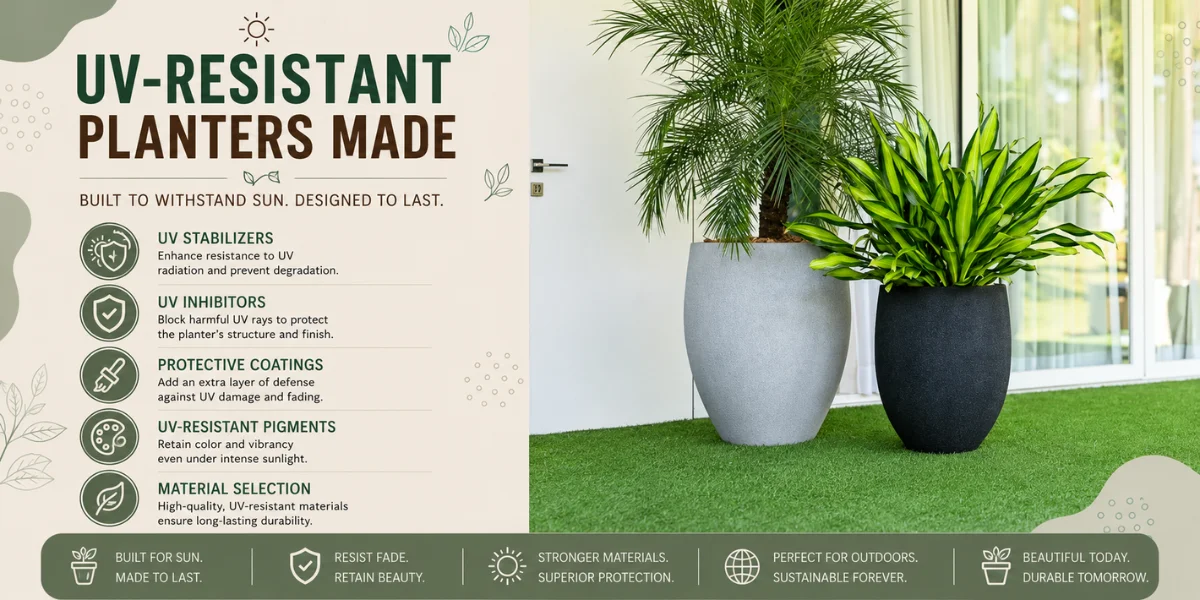
How Are UV-Resistant Planters Made?
UV resistance can be achieved in several ways depending on the material and manufacturing technology.
UV Stabilizers
Certain plastic and polymer planters can incorporate UV stabilizers into the material. These additives help reduce the effects of ultraviolet radiation on the polymer structure.
UV Inhibitors
UV inhibitors can help absorb or limit the impact of UV radiation before it causes significant degradation of the material.
Protective Coatings
Some planters use protective surface coatings or treatments designed to improve resistance to sunlight and weathering.
UV-Resistant Pigments
The pigments used in a planter can also influence how well its colour performs outdoors. Certain pigments offer better resistance to fading than others.
Material Selection
The base material itself plays a major role. Some materials naturally perform better outdoors, while others require additional UV stabilisation.
A high-quality outdoor planter therefore depends on more than simply adding a “UV-resistant” label. The material, additives, manufacturing process, thickness, finish, and intended application all influence performance.
What makes a planter UV resistant?
UV resistance may come from the planter’s base material, UV stabilizers, UV inhibitors, pigments, coatings, or a combination of these technologies.
Are UV-resistant additives used in plastic planters?
Yes. UV stabilizers and related additives are commonly used in outdoor polymer products to improve resistance to sunlight.
Does planter colour affect UV performance?
It can. Different pigments have different levels of resistance to UV exposure, so colour formulation can influence long-term appearance.
Can a coating make a planter UV resistant?
A suitable protective coating can improve resistance to sunlight, depending on the coating technology and substrate.
Is thicker material always more UV resistant?
Not necessarily. Thickness can influence durability, but UV resistance depends heavily on the material formulation, stabilizers, pigments, manufacturing quality, and design.
How can I know whether a planter is genuinely UV resistant?
Check the manufacturer’s product specifications and ask about the material, UV stabilisation, intended outdoor use, testing, and warranty where applicable.
Best Materials for UV-Resistant Planters
Different planter materials offer different levels of outdoor performance.
UV-Stabilized Plastic
High-quality UV-stabilized plastic is widely used for outdoor planters because it can be lightweight, durable, versatile, and available in numerous shapes and colours. It is especially practical for balconies, terraces, commercial landscapes, and large-scale installations where moving planters may occasionally be necessary.
Fiberglass and FRP
Fiberglass-reinforced materials can offer a combination of strength, relatively low weight, and design flexibility. With appropriate outdoor-grade finishes and UV protection, fiberglass planters can work well in demanding outdoor environments.
Metal
Metal planters can provide excellent structural strength and a contemporary appearance. However, UV resistance alone is not the primary consideration. The coating, paint, corrosion protection, and metal type are equally important for outdoor performance.
Stone and Concrete
Stone and concrete are naturally suitable for many outdoor applications and are generally not affected by UV radiation in the same way as polymers or painted finishes. However, their weight, porosity, cracking risk, and installation requirements need to be considered.
Composite Materials
Composite planters can combine the properties of different materials. Their outdoor performance depends on the specific composite formulation and protective finish.
The best material ultimately depends on the location, planter size, climate, design requirements, weight limitations, maintenance expectations, and budget.
Which material is best for UV-resistant planters?
There is no single best material for every application. UV-stabilized plastic, suitable fiberglass or composite materials, and properly finished metal can all perform well outdoors.
Are plastic planters UV resistant?
Some are. Outdoor-grade plastic planters can be manufactured with UV stabilizers to improve resistance to prolonged sunlight.
Are fiberglass planters suitable for outdoor use?
Yes. Fiberglass planters can be suitable for outdoor applications when they use appropriate materials and UV-resistant finishes.
Are metal planters affected by UV rays?
The metal itself is generally less vulnerable to UV degradation than many plastics, but paint and surface coatings can fade or deteriorate under sunlight.
Are concrete planters UV resistant?
Concrete is generally highly resistant to UV exposure, although surface coatings, paints, sealants, and other finishes may respond differently.
Which planter material is best for hot and sunny locations?
Outdoor-grade UV-stabilized polymers, suitable composites, fiberglass, concrete, and properly finished metals can all work, depending on the specific conditions and design requirements.
UV-Resistant Planters for Indian Climates
India has diverse climatic conditions, ranging from humid coastal environments to hot and dry regions and areas with intense summer sunlight.
For outdoor planters, UV resistance is especially relevant in locations where containers receive prolonged direct sunlight.
In cities such as Mumbai, Goa, Delhi, Ahmedabad, Bengaluru, Hyderabad, Chennai, and Pune, planter selection should consider not only UV exposure but also humidity, monsoon rainfall, temperature fluctuations, drainage, and maintenance requirements.
For coastal areas, additional attention should be given to moisture and salt exposure. For rooftops and terraces, heat buildup and direct sunlight can be significant considerations.
Weather resistance
Appropriate drainage
Structural durability
Easy maintenance
Suitable material thickness
Good colour retention
Resistance to moisture where required
UV resistance is one component of outdoor durability, rather than the only specification that matters.
Are UV-resistant planters suitable for Indian summers?
Yes. They are particularly useful in outdoor spaces exposed to strong and prolonged sunlight.
Are UV-resistant planters suitable for Mumbai?
Yes. In Mumbai, UV resistance can help with strong sunlight, while moisture, monsoon rainfall, and humidity should also be considered.
Can UV-resistant planters be used in Goa?
Yes. For Goa’s outdoor environments, UV resistance is useful, but the planter should also be suitable for humid and rainy conditions.
What should I consider when buying planters for Indian outdoor spaces?
Consider UV resistance, weather durability, drainage, material quality, planter weight, maintenance, size, and the specific local climate.
Are UV-resistant planters suitable for terraces?
Yes. They are well suited to terraces because these spaces often receive direct sunlight for extended periods.
Do monsoons affect UV-resistant planters?
UV resistance specifically addresses ultraviolet exposure. For monsoon conditions, the planter should also have appropriate weather resistance, drainage, and moisture durability.
Where Can UV-Resistant Planters Be Used?
UV-resistant planters are suitable for a wide range of outdoor environments.
Balconies
Balcony planters can receive intense sunlight depending on their orientation. UV-resistant containers can help maintain a consistent appearance.
Terraces and Rooftops
Open rooftops typically have high exposure to sunlight and weather. Durable planters are particularly useful in these environments.
Gardens
UV-resistant planters can be used to create focal points, define garden areas, display seasonal plants, or organise container gardens.
Patios
Large decorative planters can add greenery to residential patios while complementing outdoor furniture and architectural finishes.
Hotels and Resorts
Hospitality properties often use planters to create attractive entrances, walkways, poolside areas, restaurants, and landscaped public spaces.
Restaurants and Cafés
Outdoor planters can create visual separation, add greenery, and improve the atmosphere of dining spaces.
Offices and Commercial Buildings
Planters can be used around entrances, terraces, reception areas, courtyards, and other commercial outdoor spaces.
Public and Landscape Projects
Large-scale landscaping projects can benefit from durable planters designed for long-term outdoor exposure.
Can UV-resistant planters be used on balconies?
Yes. They are suitable for balconies, especially those receiving direct sunlight.
Are UV-resistant planters good for rooftops?
Yes. Rooftops are among the environments where UV-resistant planters can be particularly useful.
Can hotels use UV-resistant planters?
Yes. They can be used in hotel entrances, gardens, terraces, poolside areas, restaurants, and other outdoor spaces.
Are UV-resistant planters suitable for restaurants?
Yes. They can be used to add greenery and define outdoor dining areas while maintaining a consistent appearance.
Can UV-resistant planters be used for commercial landscaping?
Yes. Their durability and appearance make them suitable for many commercial landscaping applications.
Can large UV-resistant planters be used outdoors permanently?
They can be designed for long-term outdoor use, provided the planter’s material, drainage, installation, and environmental specifications are appropriate.
Benefits of Choosing UV-Resistant Planters
Choosing a UV-resistant planter provides several practical and aesthetic advantages.
1Longer-Lasting Appearance
UV protection helps reduce the visual effects of prolonged sunlight exposure.
2Better Colour Retention
Planters can maintain their intended colour for longer, helping outdoor spaces remain visually consistent.
3Improved Durability
Appropriate UV stabilisation can help reduce degradation associated with sunlight.
4Lower Maintenance
When the planter surface remains stable, less frequent replacement or cosmetic restoration may be required.
5Better Value Over Time
A durable planter can provide better long-term value when compared with repeatedly replacing lower-quality containers.
6Greater Design Flexibility
UV-resistant planters are available in different shapes, sizes, colours, textures, and finishes, making them suitable for both functional and decorative landscaping.
What is the biggest benefit of UV-resistant planters?
One of the main benefits is improved resistance to sunlight-related deterioration, helping the planter retain its appearance and performance for longer.
Do UV-resistant planters require less maintenance?
They can require less replacement and cosmetic maintenance because they are designed to better withstand prolonged sunlight exposure.
Are UV-resistant planters more durable?
They can be more suitable for long-term outdoor use because UV protection helps reduce degradation caused by sunlight.
Are UV-resistant planters worth the investment?
For outdoor applications with significant sunlight exposure, they can be a worthwhile investment because durability and colour retention can reduce replacement needs.
Can UV-resistant planters improve outdoor aesthetics?
Yes. Better colour retention and finish stability can help maintain the visual appearance of landscaped areas.
Are UV-resistant planters suitable for professional landscaping?
Yes. They can be a practical option for residential, hospitality, commercial, and landscape-design projects.
How to Choose the Right UV-Resistant Planter
UV resistance should be considered alongside other important planter specifications.
Check the Material
Ask what material the planter is made from and whether it is specifically formulated for outdoor use.
Ask About UV Stabilization
Look for information about UV stabilizers, UV inhibitors, outdoor-grade materials, or UV-resistant finishes.
Consider the Location
A planter placed under partial shade has different requirements from one installed on an exposed rooftop.
Select the Correct Size
The planter should provide sufficient space for the plant’s root system while remaining appropriate for the available area.
Check Drainage
Good drainage is essential for healthy plants. Ensure the planter design allows excess water to escape effectively.
Consider Weight
Large outdoor planters may need to be lightweight enough for installation while still being stable in windy conditions.
Evaluate the Finish
For visible architectural or landscape installations, consider colour consistency, texture, surface finish, and overall design.
Ask About Warranty and Specifications
For commercial or large-scale projects, product documentation and warranty information can help evaluate expected outdoor performance.
What should I check before buying a UV-resistant planter?
Check the material, UV protection, dimensions, drainage, weight, finish, intended outdoor use, and manufacturer specifications.
How do I know if a planter is suitable for full sun?
Look for manufacturer information confirming outdoor and full-sun suitability, along with details about UV stabilisation or weather resistance.
Should I choose a lightweight UV-resistant planter?
Lightweight planters can be useful for balconies, terraces, and locations where installation or movement is difficult, but sufficient stability is also important.
Why is drainage important in an outdoor planter?
Drainage prevents excess water from accumulating around plant roots, which can contribute to root problems.
Does planter size matter for outdoor plants?
Yes. The planter should provide enough room for the plant’s roots and be appropriate for the plant’s mature size.
Should I ask for UV-resistance specifications?
Yes. Especially for commercial projects, ask the manufacturer about UV stabilisation, outdoor testing, expected performance, and warranty coverage.
UV-Resistant vs. Regular Planters: What Is the Difference?
The primary difference is how the planter is designed to respond to prolonged sunlight exposure.
A regular planter may not contain sufficient UV stabilizers or use a material specifically formulated for outdoor exposure. Over time, direct sunlight can cause fading or material degradation depending on the construction.
A UV-resistant planter is designed with outdoor exposure in mind.
| Feature | UV-Resistant Planter | Standard Planter |
|---|---|---|
| UV protection | Designed for improved UV resistance | May have limited protection |
| Colour retention | Generally better under prolonged sunlight | May fade faster |
| Outdoor suitability | Designed for outdoor environments | Depends on material |
| Long-term appearance | Better suited to maintaining appearance | May deteriorate sooner |
| Best application | Sun-exposed outdoor spaces | Indoor or lower-exposure applications |
The actual performance will always depend on the product’s material, formulation, construction, environmental conditions, and maintenance.
Are UV-resistant planters better than regular planters?
For areas with prolonged sunlight exposure, UV-resistant planters are generally the more appropriate choice.
Do regular plastic planters fade faster?
They can, particularly when they lack adequate UV stabilization and are exposed to direct sunlight for long periods.
Are UV-resistant planters more expensive?
They may cost more depending on their material, manufacturing process, finish, and construction, but the additional durability can provide long-term value.
Can a regular planter be used outdoors?
Some regular planters are suitable for outdoor use. However, always check the manufacturer’s specifications, particularly for direct sunlight.
Is UV resistance important for decorative planters?
Yes. It can be particularly valuable when maintaining the colour and appearance of decorative planters is important.
Should commercial projects choose UV-resistant planters?
They can be a strong option for commercial projects where planters are exposed to sunlight and consistent appearance and durability are important.
How to Maintain UV-Resistant Planters
Even durable outdoor planters benefit from proper maintenance.
Clean the Surface Regularly
Dust, dirt, pollution, and other deposits can accumulate on outdoor planters. Cleaning the surface periodically helps maintain its appearance.
Avoid Harsh Chemicals
Use cleaning products recommended for the specific planter material. Aggressive chemicals can damage certain finishes.
Check Drainage
Ensure drainage openings remain clear and are not blocked by soil, roots, or debris.
Inspect for Damage
Periodically check planters for cracks, impact damage, loose components, or deterioration.
Follow Manufacturer Guidelines
Different materials have different cleaning and maintenance requirements. Manufacturer recommendations should take priority.
Do UV-resistant planters need maintenance?
Yes. UV resistance reduces sunlight-related degradation but does not eliminate the need for cleaning and inspection.
How often should outdoor planters be cleaned?
Cleaning frequency depends on location, pollution, dust, rainfall, and the planter’s surface. Inspecting them periodically is a good practice.
Can I use strong chemicals to clean planters?
It is better to avoid harsh chemicals unless the manufacturer specifically recommends them.
Should I check drainage holes regularly?
Yes. Blocked drainage can affect plant health and cause excess water accumulation.
Can UV-resistant planters be pressure washed?
This depends on the planter material and finish. Check the manufacturer’s cleaning instructions before using high-pressure water.
How can I extend the life of an outdoor planter?
Use the planter according to its specifications, maintain proper drainage, clean it appropriately, inspect it regularly, and follow the manufacturer’s care recommendations.
Are UV-Resistant Planters Eco-Friendly?
UV resistance and environmental sustainability are related but not identical concepts.
A planter being UV resistant does not automatically mean it is eco-friendly planters. Environmental performance depends on factors such as the material used, manufacturing process, durability, recycled content, recyclability, product lifespan, and end-of-life disposal.
A durable planter can potentially contribute to lower replacement frequency because it is designed to remain functional for longer. However, sustainability should be evaluated across the product’s complete lifecycle.
When sustainability is important, ask manufacturers about their material sourcing, recyclability, and long-term environmental impact.
Conclusion
UV-resistant planters are designed to handle prolonged exposure to sunlight while helping maintain their colour, finish, and overall outdoor performance. They are especially useful for balconies, terraces, rooftops, gardens, patios, hospitality properties, commercial spaces, and landscape projects exposed to strong sunlight.
When choosing an outdoor planter, look beyond the term “UV resistant.” Evaluate the material, UV stabilization, weather resistance, drainage, size, weight, finish, maintenance requirements, and manufacturer’s specifications.
For sunny outdoor environments, selecting a planter specifically designed for prolonged UV exposure can be an effective way to create a more durable, attractive, and reliable landscaping solution.
How long do UV-resistant planters last outdoors?
The lifespan depends on the material, UV protection, manufacturing quality, climate, and maintenance. High-quality outdoor planters can remain functional and attractive for many years when properly maintained.
Can UV-resistant planters be left outside all year?
Yes. Planters specifically designed for outdoor use can generally remain outside throughout the year. However, their suitability depends on local weather conditions and the manufacturer’s specifications.
Do UV-resistant planters become hot in direct sunlight?
Yes, like most outdoor containers, they can heat up when exposed to strong sunlight. The effect on the plant depends on the planter material, colour, size, location, and the surrounding temperature.
Can UV-resistant planters withstand heavy rain?
Many outdoor-grade UV-resistant planters can withstand rain, but UV resistance itself does not guarantee waterproof or weatherproof performance. Check whether the planter is rated for outdoor weather exposure.
Are dark-coloured UV-resistant planters suitable for full sun?
They can be, but dark colours generally absorb more solar heat than lighter colours. For heat-sensitive plants, location, ventilation, planter material, and plant requirements should also be considered.
Can UV-resistant planters be used for large plants and trees?
Yes, provided the planter has sufficient depth, width, structural strength, drainage, and stability for the plant’s mature size and root system.
Can UV-resistant planters be moved easily?
It depends on their size and material. Lightweight UV-resistant planters are easier to reposition, while large planters may require plant caddies, wheels, or mechanical assistance.
Do UV-resistant planters need to be covered during extreme weather?
Not necessarily if they are designed for the local outdoor conditions. However, protection may be useful during unusually severe weather, depending on the planter material and installation.
Can UV-resistant planters be customised?
Some manufacturers offer custom sizes, colours, shapes, finishes, branding, or designs. Customisation options vary by manufacturer and material.
Can UV-resistant planters be used in high-rise buildings?
Yes, but rooftop and high-rise installations require additional consideration of planter weight, wind stability, drainage, waterproofing, and building-specific safety requirements.
Are UV-resistant planters suitable for landscaping projects?
Yes. They can be used for residential, hospitality, commercial, institutional, and public landscaping projects where planters are exposed to sunlight and weather.